University Projects (5) ...
Year: 1999
Programming Language & Tools: Turbo C Ver 4.5
Title: Memory Management Simulation
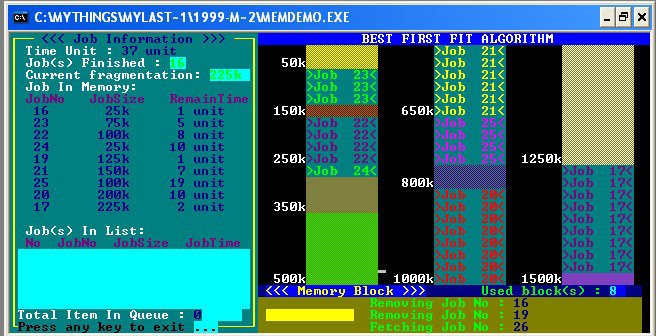
This simulation is built in order to simulate the effectiveness of 3 type of memory management algorithm using in our OS in the "ancient" time. The first type is: "First-Fit algorithm". (Please refer to your OS text book to know in detail.). Second type is: "Best fit algorithm". The third algorithm simulated in this system is: Best First Fit algorithm which the author produced it by combining the advantages from the previous 2 algorithms. The simulation was implemented with a time unit where each random generated job has a certain size and time unit needed to be remained in memory.
In this simulation, several pre-defined size of memory segments were created initially. Each memory segment will have different memory blocks in size. Different algorithms will have different mechanism in choosing which memory segment to load the generated jobs in order to minimize the wasted memory blocks and have the most jobs loaded into memory at the same time. In other words, there will be minimum number of jobs waiting in the queue to be loaded. This is one of the best simulator has been built in DOS mode using C by the author. You perhaps can have a try and run the program in full screen DOS mode.
More ...
Year: 1999
Programming Language & Tools: Assembly Language
Title: Simple Mathematic Linear Line Graph Plotter
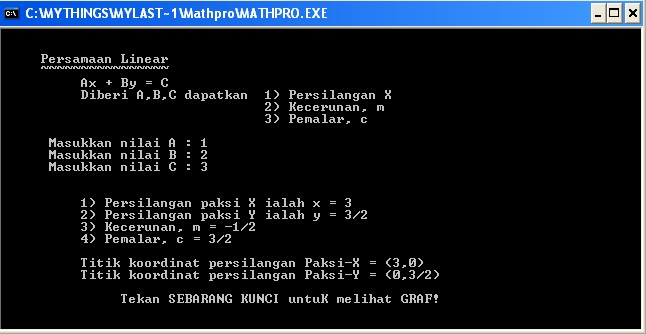
This simple application is actually an assignment during my first year in University Malaya. The application takes 3 parameters: A, B and C where Ax + By = C. By having this 3 values, the system need to calculate and give the interception of x-axis, the slope and the constant of a straight line equation, y = mx + c.
Furthermore, the system needs to allow the graph to be plotted on the screen after these values is calculated. The challenge is the author needed to perform the graph plotting mechanism coded using assembly language. Imagine.
More ...
Year: 2000
Programming Language & Tools: Java Applet
Title: Applet Dancing Line
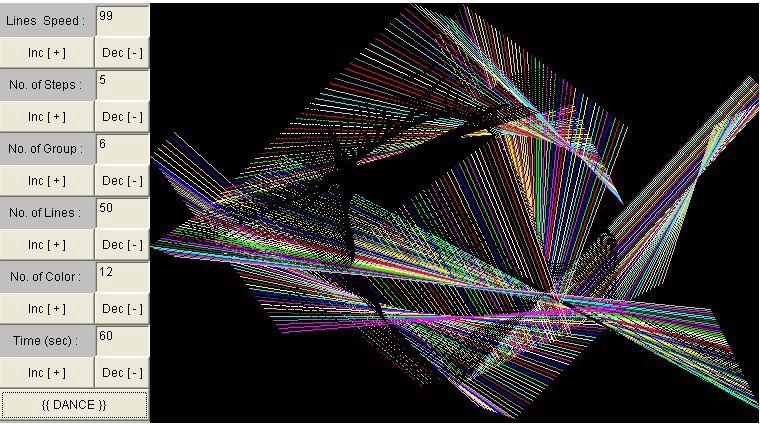
This simple demonstration of dancing line is coded using Java Applet. Various setting can be performed before you get the dancing line run on the applet window. The setting are such as the total group of line, speed, gaps between each line you want it to be and so on.
More ...
Year: 2000
Programming Language & Tools:
Java Swing
Title:
Graphics Encryption Communication System (GCCS)
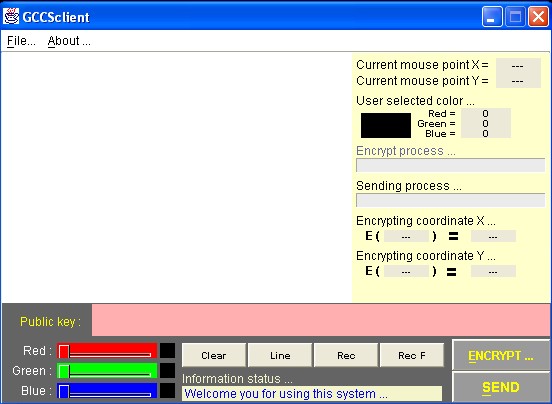
Have you ever think to encrypt your graphics during you sent your pictures over the network? The system named GCCS is actually a prototype that built to make this scenario reality!
The scenario:
1. Initially, at server site need to generate a pair of public key and private key and save it as meaningful name, eg. PubKey_[PersonName].key, PriKey_[PersonName].key.
2. Then, the public key actually can be distributed to the party that wants to sent drawing message to you via an unsecured network.
3. For the party that wants to sent message to you (at the client site), he/she need to choose the public key to encrypt the message before sent to you (the server site).
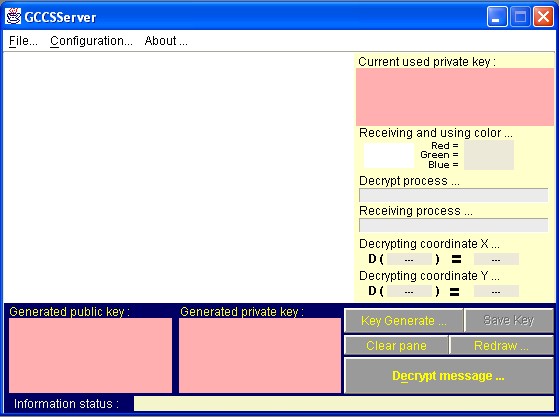
4. After the encryption process complete, user may click on the "send" button for the drawing information to transmit via any unsecure network. Screen below show the data transmission process happen at client site and the data receiving process at server side.
5. After you have received the encrypted message, you actually need to choose the corresponding private key in order to get the message decryption.
The functionality:
The server program actually can provide you to generate various number of key, such as 4, 8, ... , 128 characters. The more characters for the key, system need more time to perform the encryption and decryption process.
The client program provides some basic functionality for drawing a message before send. User friendly GUI to ease users to use this prototype.
That is really a wonderful encryption and decryption system written in JAVA. It also implemented using client server architecture. Please have a try!
More ...