Dynamic Bandwidth Allocation implementing Neural-Fuzzy Technique simulated in JAVA Network Simulator ...
Year: 2001
Programming Language: Java
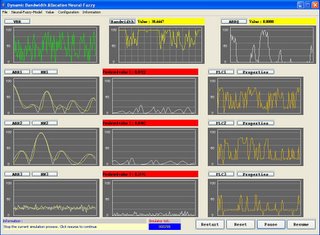
Title: Dynamic Bandwidth Allocation implementing Neural-Fuzzy (Neural Network + Fuzzy Logic) Technique simulated in JAVA Network Simulator
This system was built in order to fulfill my final year research project at University Of Malaya. A Neural-Fuzzy model was created in order to predict the next incoming bandwidth in ATM network, which contain of several channels; and intelligently adjusted suitable bandwidth allocation according to the usage pattern of each channel. The objective is to reduce the drop rate in switch buffer and maximize the usage of the outgoing bandwidth. Neural network play the role in learning and predicting the next incoming pattern from different channels. The fuzzy logic plays the role in evaluating the pre-defined user rules and intelligently adjusted the suitable bandwidth accordingly. More ...
Year: 2001
Programming Language: Java
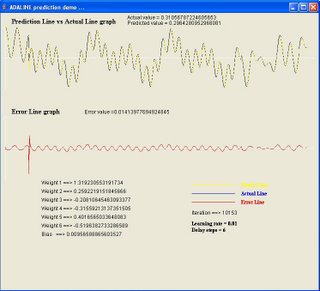
Title: Simulation ADALINE with TDL Neural Network model
This simulation is built to test the Neural Network (NN) model in learning and predicting multiple complex non-linear mathematic model. Amazingly, it works!
Concept:
1. Initiate a X value, (t = 0). The X value served as input for the trained NN model to produce the predicted value Y.
2. The author actually generated a series of 2D (x,y) coordinates by using some complex mathematic equations (i.e. 2sin(x) + 3cos(x)).
3. Obviously the predicted Y value will initially give a wrong value because of the NN model has not been trained.
The system teachs the NN model using the actual Y value generated in step 2 and repeat the step 1 again using the X value in next time step (t=1).
By performing this training mechanism to the NN model, observe that when over certain period of simulation (t > 20k), the NN model actually can obtian a good prediction of Y value.
More ...